





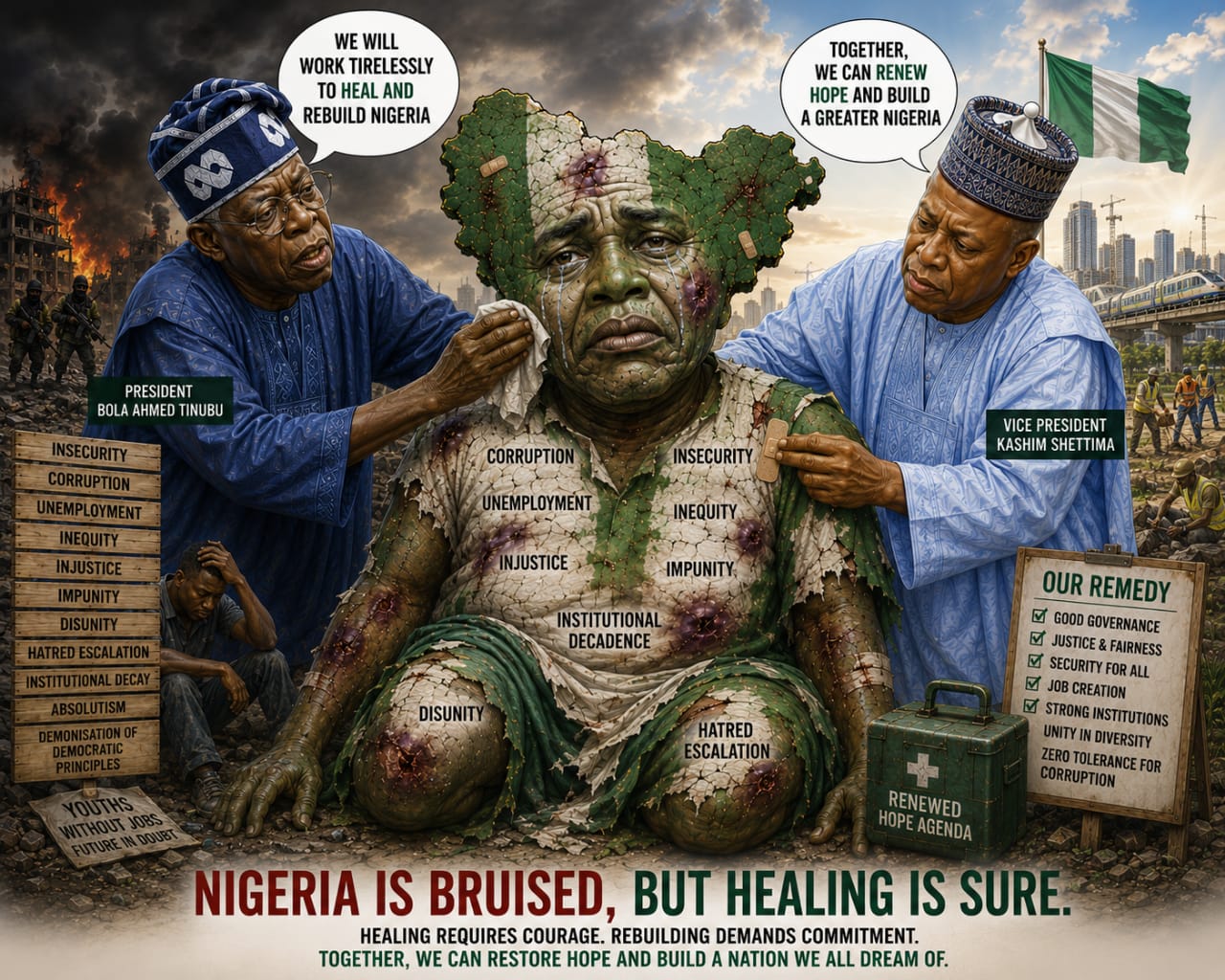
NIGERIA IS BRUISED, BUT THE WOUNDS CAN STILL HEAL
Nigeria today stands at a defining moment in its democratic journey. The challenges confronting the nation are not products of a single administration or a single period in history; rather, they are the accumulated consequences of years of institutional decline, poor governance, corruption, insecurity, unemployment, social inequality and the gradual weakening of the values that uphold a stable democracy.
The reality is that Nigeria’s greatest challenge goes beyond economic hardship or security concerns. The deeper crisis lies in the erosion of public trust, weakened institutions, limited accountability and the growing disconnect between government and the governed. When institutions fail to deliver justice, when citizens lose confidence in leadership and when opportunities become increasingly difficult to access, the foundation of democracy itself becomes threatened.
President Bola Ahmed Tinubu assumed leadership of a nation carrying the weight of these longstanding challenges. The task before his administration is therefore not merely about managing existing problems, but about confronting the structural issues that have hindered Nigeria’s progress for decades.
The question facing the country is no longer about who caused the wounds of the past. Nigerians are more interested in whether the current leadership has the courage, commitment and capacity to begin the difficult process of healing.
That healing process cannot come through promises alone. It requires bold and practical reforms that will strengthen institutions, restore confidence in governance and ensure that justice is applied fairly without discrimination. Nigeria needs a security system capable of protecting lives and property, an economy that creates opportunities for millions of unemployed citizens, and policies that place national interest above political convenience.
Democracy must return to its fundamental purpose — a system where leadership is defined by service, accountability and responsibility to the people. Public office must not be seen as a pathway to privilege, but as a platform for solving problems and improving the lives of citizens.
However, rebuilding Nigeria cannot be the responsibility of the President alone. The task requires the commitment of governors, legislators, public servants, traditional leaders, civil society organisations, the private sector and ordinary citizens. A nation cannot experience true transformation when accountability is demanded only from those in power while citizens neglect their own responsibilities.
Political leaders must demonstrate integrity. Institutions must operate independently and transparently. Citizens must demand good governance while also contributing positively to national development. The rule of law must remain the foundation upon which Nigeria’s future is built.
Despite the difficulties of the present moment, Nigeria’s greatest asset remains its people. The creativity, resilience and determination of Nigerians have continued to shine despite years of hardship and uncertainty. The nation may be bruised by past failures and political excesses, but its spirit remains alive.
Healing will not happen overnight. It will require patience, sacrifice and consistent commitment from all stakeholders. But with visionary leadership, strong institutions and a united national purpose, Nigeria can overcome its challenges and rebuild the confidence of its citizens.
Nigeria is bruised, but it is not broken. The wounds are deep, but healing is possible — if leaders and citizens alike are willing to take responsibility and work together for the future of the nation.
I can also �adapt it into a **front-page newspaper column style with a sharper headline and more political punch**.

